Category: What's New

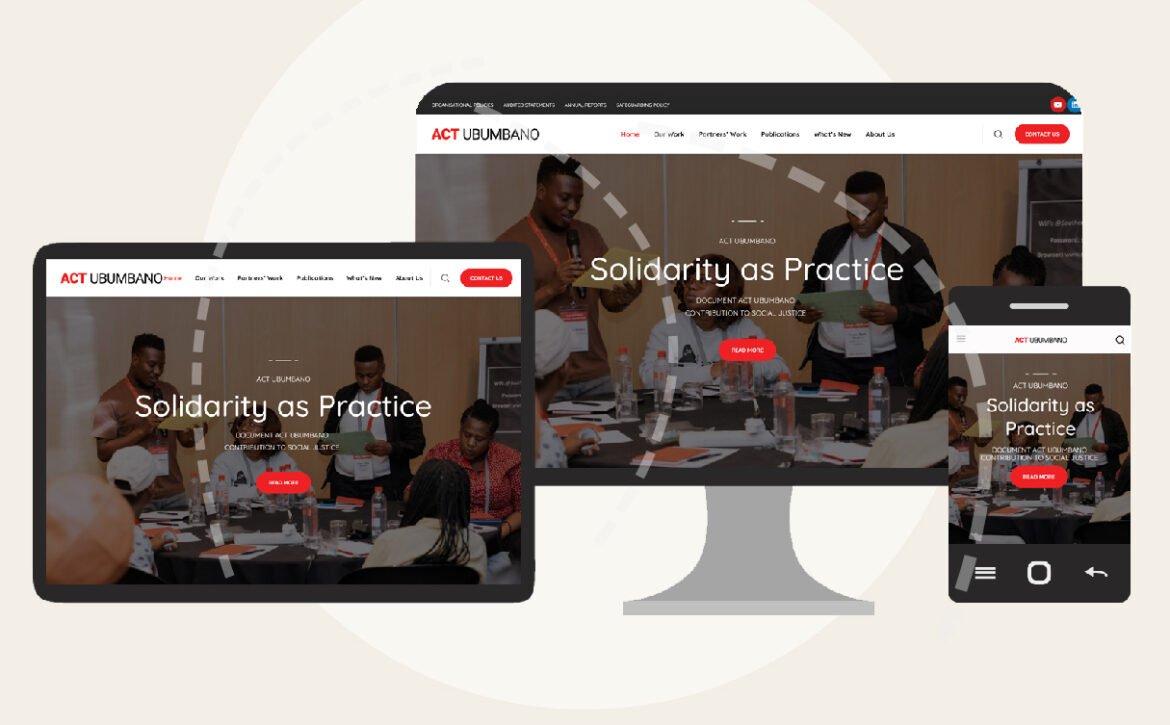
Responsive Web

Welcome to Our Vibrant New Website: Explore, Connect, and Engage!

We are excited to announce the launch of our newly redesigned website—www.actubumbano.org. This milestone signifies an important step in how we share our work, connect with our partners, and engage with communities across Southern African countries and beyond. It shows our growth toward greater accessibility, dynamism, and impact.

The site navigation is now more intuitive, making it easier to find our work, our partner information, and what is happening within our network. The new site uses strong visuals and clear content, highlighting how our work is rooted in people, communities, and lived experiences. You can now easily discover our partners’ work in solidarity with marginalised communities. Our publications section is now easier to use, providing several options to access our research and insights.

This site is built for you! Dive in, explore, and share your thoughts so we can keep improving. Visit www.actubumbano.org and let us know what you think!

Read More
Untitled-6

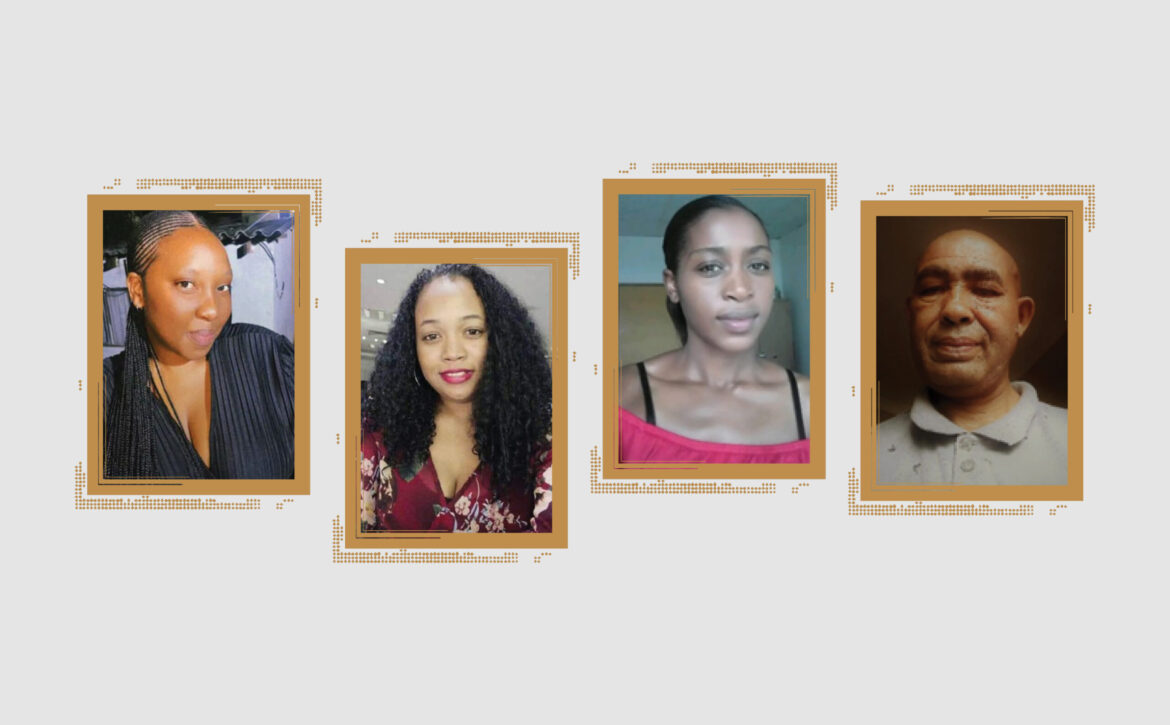
Meet the people behind the Accountability Project

The Accountability Project is an exploratory process that aims to strengthen community agency and voice in monitoring government performance in South Africa. It has three components: understanding local accountability mechanisms and how people engage with these (Community Engagement), establishing a data-driven platform to create an evidence base for accountability (Data), and working with partners to strengthen advocacy for greater government accountability (Strategy and Tactics).

Working in partnership with five civil society organisations and 10 of their community partners, the  Project facilitated 76 community engagements across five provinces.

Click here to meet the team behind the Accountability Project and learn their stories.

Read More
480b184f-cfb7-93cf-4526-e919345e63df

Solidarity Support Facility Call for Proposals

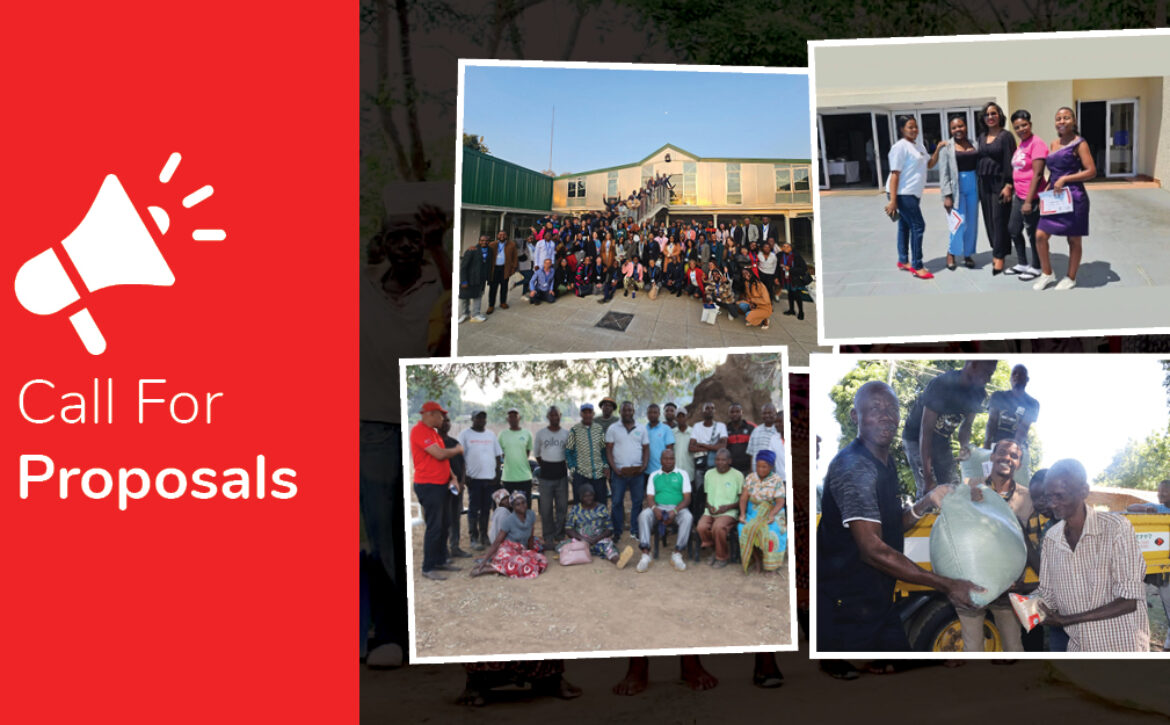
ACT Ubumbano invites proposals from community and activist organisations for funding to support actions that may be responses to the impact of environmental, gender and economic injustice on communities, or campaigns to change particular situations that communities are struggling with. The action must be implemented and completed by 30 November 2026.

If you have received at least two grants in the last four years, please do not apply to allow other organisations an opportunity. Similarly, if you have not yet provided a final report for a grant received in 2025, please do not apply. There will be another call for proposals in 2027.

Proposals may be for a maximum of ZAR30,000 (Thirty thousand South African Rands). Amounts allocated may be less than this to reach as many applicants as possible.

Proposals must be completed in full and submitted online. The deadline for submission is 14h00 (SAST) on Thursday 24 March 2026. You are encouraged to complete the online application as early as possible.

There is always an overwhelming response to this call, and assessing applications will take time. While there will be regular communication on the status of your application, you will need to find patience as the review process is happening.

What will be supported?

There is a limited budget available for this call, so ACT Ubumbano consider the following in allocating grants:

  • The proposed work is led by or directly involves people who are affected by the issue.
  • The proposed work seeks to change the root causes or conditions of injustice.
  • The proposed work has potential to bring new knowledge that can be shared with others.
  • The budget is in proportion to the action that will be undertaken.
  • The organisation has demonstrated capability to undertake the action, or has a plan to work with others who have the capability.
Who can apply?

The opportunity is open to any registered non-profit organisation or association that is part of the ACT Ubumbano network, or willing to work with ACT Ubumbano partner organisations in Botswana, Lesotho, Malawi, Mozambique, Namibia, South Africa, Swaziland (Eswatini), Zambia, and Zimbabwe.

Any funding is intended to help with taking action for change. It is not intended for general or core support for organisations, although some of the funds may be used for organisational costs.

What will NOT be supported!

ACT Ubumbano will NOT support any action that undermines the dignity of people and the earth, or that are:

  • Homophobic or discriminatory against people from the LGBTI+ community,
  • Sexist and undermining of the dignity of women,
  • Xenophobic and discriminatory against foreign nationals,
  • Generally harmful to any vulnerable or marginalised group in society, or
  • Environmentally destructive and working against efforts to fight climate change.

Furthermore, purchase of livestock, building materials, or inputs that are used in development work (sewing machines, tools, etc), cannot be supported. Relief and humanitarian work cannot be supported, nor can scholarships, school fees, and conference attendance costs.

Questions can be addressed to thabo@actubumbano.org.

Please email hub[@]actubumbano.org and copy thabo[@]actubumbano.org if you have queries or need clarification.

Read More
WhatsApp Image 2026-03-05 at 10.49.21

Something Akin to Freedom: Civil Society, Democratic Fatigue, and the Inside Work of Accountability

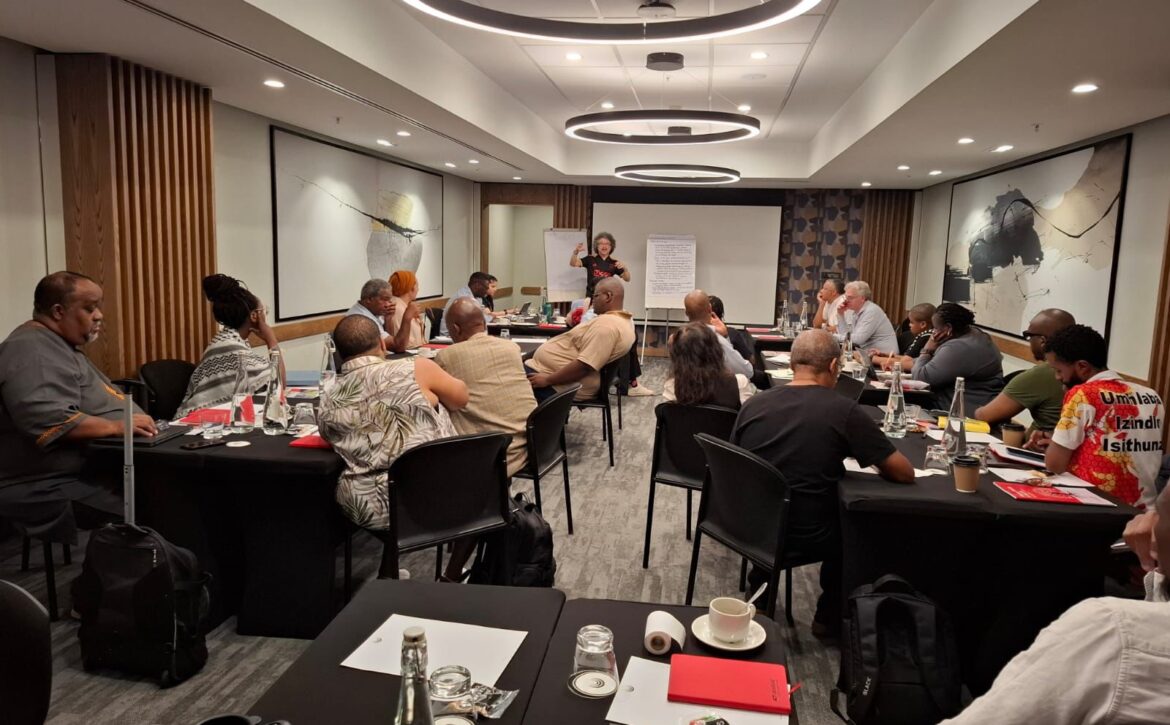
Last week, in a room in Johannesburg — small enough that someone joked we needed to turn up the aircon just to make space for honest thinking — activists, organisers, researchers, and advocates gathered for a conversation with no closing declarations, only questions worth carrying forward.

This was the Accountability Project’s strategy convening — a full day of sessions moving from the state of civil society in the GNU era to questions of corporate power, transparency, and the shrinking space for public accountability. We sat with the discomfort of asking what democratic engagement even means in 2026, on the eve of local government elections, in a country where more and more people are simply walking away from the formal democratic project.

Our conversation forms part of a longer journey: a series of conversations held across the country with community activists and affected communities, all trying to make sense of a political moment that keeps shifting beneath our feet.

At ground level, communities are increasingly fluent in local government mechanics. Independent candidates are emerging. Ward processes are being scrutinised. People understand where caucus decisions happen before the council floor. There is energy that belongs to no party and no NGO.

But that energy is emerging in a context of deep democratic fatigue. Voter participation continues to decline. A growing number of people, particularly young people, are organising outside of the structures that formal civil society recognises — not because they are apathetic, but because the formal structures have not earned their trust.

These conversations are not happening in isolation. Over this past weekend, events unfolding in Iran and the UAE have once again reminded us how fragile civic space can be — how quickly state power consolidates, how narratives are controlled, and how citizens are left negotiating fear, fatigue, and uncertainty. What’s happening beyond our borders isn’t someone else’s problem. It’s a mirror for the exact same questions we’re sitting with here – about democracy, accountability and who ultimately holds power.

The erosion is not only institutional, it is interior.

When communities in the Accountability Project’s research were asked what accountability means to them, they didn’t speak about oversight or legal mechanisms. They said: a duty of care. And when that duty is absent — when the promise isn’t kept, when the complaint is logged and nothing moves — people don’t just disengage from the mechanism. They disengage from the democratic project itself.

To make sense of what that interior erosion means — and what restoring it might require —I want to use an unconventional lens to get at something that political analysis alone keeps missing.

In the introduction to The Lemonade Reader[1], scholars Cheryl Finley and Deborah Willis describe Beyoncé’s artistic practice as drawing on centuries of spiritual tradition, black aesthetic history, and the everyday textures of black womanhood to make something that is simultaneously personal, communal, and politically alive.

A few years ago, when I first engaged with this text in a reading group led by Prof Salma Lee-Shae Scharnick-Udemans during Covid, what struck me was the argument about agency. It challenged me to reconsider how narrowly we often define the political, and how urgently we need to expand our notions of political agency beyond protest alone.

Lindsey Stewart traces the debate between two ways of understanding what black cultural production is for: Richard Wright’s demand that it face outward — toward confrontation, struggle, resistance against the oppressor — and Zora Neale Hurston’s counterclaim on something more interior, more rooted, more concerned with the fullness of self that must exist before outward struggle can be sustained (Stewart, 2019).

Hurston’s strategy in writing about the folk figure High John de Conquer[2] appears first as “a whisper”, a will to hope. Before he walks the plantation, he lives inside people. He was one who “beat the unbeatable”, not through escape from brutality or open confrontation, but through wit, spirit, and an undiminishable interior life. What he gave enslaved people, Hurston tells us, was “an inside thing to live by”.

That thing was what gave people the capacity to endure conditions designed to extinguish their sense of self. Through this reference she points us to the politics of joy. Stewart argues that it is precisely this interior work — the cultivation of self-definition, the maintenance of joy and love and dignity as political categories — that both Wright and bell hooks miss when they critique Hurston and Beyoncé’s politics. What they mistake for an absence of politics is in fact a different kind of politics: one concerned with what Zandria Robinson calls “the alignment, the stillness, the readying, the quiet, before the twerk, the turn-up, the (social) movement” (Robinson 2016).

Might this “formation” also be a way of imagining community — of turning what looks like a personal test into a shared, collective struggle? If so, then mobilising toward an interior formation offers a generative account of agency.

The question, in my view, pressing against our convening last week is whether South African civil society has neglected its own formation work.

We have mastered the grammar of rights. We litigate. We draft submissions. We attend stakeholder consultations. The Constitutional Court jurisprudence is real and significant. But as someone observed sharply in the room: “winning on paper is not the same as winning in the world”.

What came through in the closing conversations was a call for a different kind of political imagination — one that does not simply defend existing democratic institutions or demand their destruction but asks harder questions about what democratic practice actually feels like from the inside.

In my own work — whether thinking about waqf [3] as liberation infrastructure, or about accountability as care, or faith as a material ethic rather than a private comfort — I keep returning to the same tension: compliance is not transformation. And proximity to power, however flattering, is not the same as holding it accountable.

And I wonder if the crisis of this moment is not simply electoral or institutional, but spiritual in the broadest most political sense?

Not some spiritual wash or retreat. Spiritual as formation.

We are in Ramadan‚ a period that is structurally about exactly this: the interior discipline that precedes and enables outward action. The cultivation of something inside that doesn’t collapse under pressure. The practice of returning, daily, to what you actually believe and why. Ramadan doesn’t produce transformation by announcing it. It produces it through the slow, unglamorous, often painful work of showing up to the practice even when you are tired, even when the results are invisible, even when the world outside is not cooperating.

If communities are already building knowledge at the edges of formal politics, already asking harder questions about who makes decisions and where, how does civil society meet that energy without instrumentalising it?

So, I don’t want to end with answers. I want to end with a question, inspired from the room, and that I think deserves to stay open.

What is the inside thing we are cultivating now, in our organisations, in our movements, in ourselves — that will determine what kind of democracy becomes possible next?

 [1] Brooks, Kinitra D., and Kameelah L. Martin, eds. 2019. The Lemonade Reader: Beyoncé, Black Feminism and Spirituality. New York: Routledge.

[2] Hurston, Zora Neale. 1943. “High John de Conquer”. The American Mercury 57 (October): 450–458.

[3] A waqf is a permanent Islamic charitable endowment whose assets cannot be sold or transferred, with only the proceeds used to support social causes.

Read More
182

What’s Happening Around Tembisa

Many of the people in Tembisa believe in making money from selling cooked food. Their marketplace is outside shopping complexes, taxi ranks etc. What is worrying now is that they defy lockdown rules and regulations but only remember them when they clash with law enforcement agents. I witnessed men cooking and selling mogodu just outside a shopping complex attracting many customers at the same time but not practicing social distancing. Ekurhuleni is one of the metros with many cases of the virus which makes it a hotspot of the pandemic, but I have realised that people only put on masks to be allowed into the mall but remove them as soon as they leave the complex.

Meanwhile, it is also worrying how those who are entrusted with distribution food parcels are helping themselves first before the people who are in real need of the food. This is even though we are in a situation where many people have lost their livelihoods and can no longer afford to fend themselves and their families. In Vusimuzi, the community registered to get food parcels, a list of names of people who registered was used to get food parcels.

On another note, these days, SAPS has been at the forefront ensuring that citizens adhere to rules and regulations of the lockdown. Before entry at the Tembisa police station, officers scan people to check their temperature and the officers record each person’s temperature, they have also implemented a no mask no entry principle at their premises whilst enforcing social distancing. I have witnessed the same at Spar Supermarket although they do not check temperature, but the principle of no mask no entry is enforced.

Read More
f42cf131-4da6-8c88-caf3-c2daa7cee960

Is your community-led impact hidden? It’s time to step into the spotlight

EPIC-Africa has officially launched the 2026 African CSO Awards, and they are looking for the “quiet champions” of community-led development. If your organisation is rooted in local action, or if you know an individual leader who deserves continental recognition, this is the moment to share that story.

Bonus: All entrants gain automatic access to the African CSO Platform for peer networking and funding leads.

Deadline: 28 February 2026

Enter or nominate here.

Read More
848e50fd-5324-fc56-2cf4-03dcb7af523a

Environmental Justice Fund: Apply for Support

The Environmental Justice Fund (EJF) supports campaigns and projects designed to advance environmental justice. They also assist community-based organisations to strengthen their organisational capacity, develop their leadership, build their networks and build their sustainability over the long term.

They fund projects in areas such as climate justice, air pollution, mining, food sovereignty, water, protection of oceans and coasts, waste management, ecofeminism, eco-socialism, land rights, indigenous knowledge, sustainable livelihoods, environmental health, access to environmental information, and community participation in natural resource decisions.  EJF also consider applications outside of these areas if they still fall within the ambit of environmental justice.

Click here to read more about this fund at apply for support.

Read More
bdb77ba5-643e-2081-e4e1-cbe8d1a51508

What do South Africans say about the GNU?

A year after the formation of the GNU, South Africans are expressing deep frustration over governance, service delivery and economic conditions. Sivio Institute, with support from ACT Ubumbano,  undertook the 2025 Citizens’ Perceptions and Expectations (CPE) Survey that captured the voices of 3,156 adults across all 9 provinces. The report shows a country losing trust in its leaders but not in its democratic aspirations. South Africans remain deeply invested in a future built on transparency, integrity, economic opportunity and meaningful participation. The message to the GNU is clear: citizens want action, accountability and a renewed social contract capable of delivering the prosperity they continue to believe is possible.

The full report is available at this link – South African Voices – CPE Report

Read More
c149a865-fc40-cd2e-8a41-14419f64e0d8

Welcome to 2026

The holidays passed by in the blur, but the ACT Ubumbano team is renewed in its commitment to support community struggles. We hope your 2026 is full of hope that is realised, joy that is tangible, and love that defines our relationships. There are a number of things to look out for. In February we will activate the Solidarity Support Facility for small grants to local action. The Outcomes Harvesting Report will be published – you can read what our partners have to say. And the Solidarity Hub 2026 will happen in the week of 12 October. You will notice the new features in the Newsletter that allow you to share it widely – please do. And soon we will re-launch our website to make interaction that much easier. Watch this space.

Read More