By Zenzile
The Violence of Development
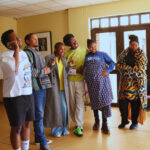
I have been sitting with these thoughts since we left Jozi, trying to make sense of what we shared together in those two days at the Jesuit Institute in Auckland Park. It was midwinter and cold, and about thirty of us gathered there, community organisers, agitators, pastors, priests, theologians and academics from South Africa, Zimbabwe and Namibia. We came together under the “Faith in Solidarity” initiative to pause and think about what it means to bear witness in a world that is increasingly shaped by a politics and practice of death. At the centre of our discernment was the prophetic mandate of Jeremiah 6:16: “Stand at the crossroads and look; ask for the ancient paths, ask where the good way is, and walk in it.”
Reflecting on that gathering, I keep returning to the idea of development and what it has actually done to people like us. The whole framework of global development was formally set in motion by Harry Truman’s 1949 Inaugural Address, specifically in what he called “Point Four.” Truman looked at more than half the world and described those people as living in “conditions approaching misery,” with economic lives he called “primitive and stagnant.” His solution was simple in his mind: apply Western scientific, technical and industrial knowledge, and the suffering would be relieved. Greater production, he said, was the key to prosperity and peace. Development was presented as a gift, a universal path that everyone should follow.
But decolonial scholars and post development thinkers have shown us something different. The Colombian-American anthropologist Arturo Escobar argues that development worked to “unmake” the Third World. It did this through the forms of knowledge it produced about poor countries, the systems of power it used to manage those countries, and the kinds of human beings it tried to create. This whole apparatus colonised our imagination. It forced diverse cultures to abandon their own philosophies, their ancestral ways of understanding the world, their relational and communal ways of living, all so that they could join a long march toward modernity and capitalist markets.
The Martinican psychiatrist and philosopher Frantz Fanon put it very bluntly. He described the colonial world as deeply divided. The settler’s town is brightly lit, made of stone and steel. The native town, the reservation, the township is hungry, on its knees, wallowing in mud. Colonial development, Fanon pointed out, hardly ever uplifts a whole country. It extracts natural resources to serve the industrial needs of the mother country and leaves the rest of the territory to sink further into poverty.
Standing at the crossroads in Johannesburg and really looking at the world is not a safe or comfortable act. You risk getting knocked down by the traffic. You irritate the hurried travellers who are in a rush to cross, because you are standing in their way. You might even become part of the gridlock that crossroads often are. But standing at those tumultuous meeting points of humanity is the only way to break through the spatial divisions of the modern colonial city and find genuine companionship with fellow sojourners. It allows a moment of collective pause to understand the context in which we live and practice our faith, and to map out the options before choosing which way to go.
Systematic Deprivation and Development as Structural Sin
One of the most important things I sat with in Jozi was the insistence that poverty is not natural. It is not the original condition of humanity that development comes to fix. Liberation theologians and decolonial critics are very clear about this. The founder of Latin American liberation theology, Gustavo Gutiérrez, writes:
“But the poor person does not exist as an inescapable fact of destiny. His or her existence is not politically neutral, and it is not ethically innocent. The poor are a by-product of the system in which we live and for which we are responsible.”
For Gutiérrez, poverty is not an abstract concept or a call for charity. It means death through the denial of basic needs, the exploitation of labour and the unjust restriction of personal freedom. It demands the construction of a completely different social order, not just better development programmes.
This is the same diagnosis that political theologians in South Africa have made. Allan Boesak puts it plainly: the poor are poor because the rich are rich. Poverty and unemployment are not accidents of history but are deliberate and indispensable components of capitalism as an economic system. The Black theologian Simon Maimela said to the South African Council of Churches in 1982 that it is a sin against God that black people have been sentenced to lives of poverty, overcrowded and crime-ridden townships, and other forms of legalised dehumanisation. His theology insisted that we must actively work to straighten out the crooked structures of the world.
These structural realities were not abstract for us in that room in Auckland Park. When Juliet asked “How do we make the ends meet? “What does it mean to be human?”, she was pointing directly at the systematic negation of humanity that characterises life under neoliberal capitalism. When Zodwa asked “Is it worth paying for education?” she was critiquing the commodification of essential social needs under a state that has chosen privatisation and market-driven thinking over redistribution. When Pokie asked “Are black women sustaining their lives in a world of domination?” she was naming the way that modern capitalist development disproportionately exploits and marginalises black women, reducing them to cheap and vulnerable labour while destroying the social safety nets that once held communities together.
What also stayed with me was Ashley Green-Thompson’s reflection on how often the church itself becomes a shield for the very deprivation it should be contesting. Too often there is judgement, moralistic superiority and the marginalisation of vulnerable people through systemic exclusions like patriarchy, misogyny and homophobia. These are things that stand in direct contradiction to the basic command to love one another. Under this compromised order the church uses charity to avoid standing in active solidarity with poor communities in their fight against the systems that impoverish them. James Cone made the same point when he argued that many congregations set up welfare programmes, food ministries and hospital visits precisely to avoid any structural challenge to the capitalist relations that produce the misery in the first place.
Sacred Texts, Whiteness, and the Site of Struggle
To sustain the developmentalist and colonial project, Western modernity needed a highly refined process of socialisation that co-opted religious and theological frameworks to legitimise expansion and dispossession. The theologian Willie James Jennings, in his book “The Christian Imagination,” shows how Western theology was taken up by the forces of imperialism and colonialism to provide an ideological foundation for a racialised imagination that justified slavery and the theft of land. This “diseased social imagination” emerged through the forcible removal of non-European peoples from their homelands, and it inflicted an incalculable loss of identity, because identity is fundamentally tied to the land.
In this colonial scheme, Christian theology used what Jennings calls a “supersessionist hermeneutic” to separate faith from geographic belonging. This interpretive move allowed missionaries to dislodge particular identities from particular places. Displaced peoples were then reclassified using objectifying categories and measured by their proximity to whiteness, which had become the primary marker of identity and civilisation. The land itself was stripped of its relational depth and turned into a commodity to be cleared, organised and brought into productive use. Jennings warns that unless this deformity is addressed, all theological talk about reconciliation will remain an ideological tool for managing power, not transforming it.
This domestication of theology is also heavily dependent on what Green-Thompson identified during our gathering: the literal, uncritical and blind interpretation of sacred texts as if they have the miraculous ability to morph into “how to” manuals for every human situation and context. The South African biblical scholar Itumeleng Mosala argued that the biblical text itself is a contested “site of struggle,” compiled and edited by ancient ruling elites to consolidate their class interests. Reclaiming the suppressed and organic voices of the poor requires breaking through this domesticating hermeneutic, and it is a process that carries real structural danger.
Standing at the crossroads and asking for an alternative path is to embrace a radical vulnerability. In an institutional landscape where certainty and technical expert knowledge are highly valued, the admission of not knowing is weaponised as a weakness. Raising critical questions about systemic injustice carries severe personal and structural risks. As Green-Thompson reflected, when you ask questions of authority, you are in danger of being cast out as a troublemaker. Institutional power, whether religious or secular, remains intact by limiting the questioning of that power. We heard this captured sharply in that folk idiom during the workshop: “It is not the role of the cow to ask the farmer what he does with the milk.” Both colonial capitalism and clerical hierarchies demand absolute and unthinking obedience from the marginalised, making critical curiosity a dangerous and rebellious act.
To counter this theological captivity, liberation theologians have made a radical epistemological break. In the United States, the pioneer of Black Liberation Theology, James H. Cone, confronted the white theological establishment by insisting that the starting point of all theological expression must be the concrete plight of the oppressed. Cone argued that either God is identified with the oppressed to the point that their experience becomes God’s experience, or God is a God of racism. For Cone, the gospel of Jesus is not a rational concept to be explained in a theory of salvation. It is a story of God’s solidarity with the oppressed. He was scathing about white churches that prioritised purchasing and building expensive structures over feeding and housing the poor. Without concrete signs of divine presence in the lives of the poor, Cone warned, the gospel becomes simply a drug that helps the powerless adjust to this world by looking for “pie in the sky.”
These theoretical deconstructions of space, identity and texts find a concrete voice in the questions that came out of our Act Ubumbano gatherings. When Errol asked “Can we escape this anti-black world?” he was articulating the profound existential confinement described by both Cone and Fanon, a world structured by whiteness that systematically negates black humanity. When Mavuso asked, “What was taken from us?” and Kgaogelo asked, “How do we relate to God?” they were tracing the historical trauma of colonial land dispossession and trying to reconstruct a theology of immanence that honours the sacredness of the physical landscape and the bodies that inhabit it. Skhu’s reflection on “contending with lived experiences and faith” mirrors Mosala’s insistence that the concrete struggle of the marginalised must be the primary lens through which the sacred is interpreted, rejecting the sterilised and Eurocentric theology that has historically served the interests of the ruling class.
Grassroots Mobilisation and the Act Ubumbano Dialogue
The theoretical claims of liberation theology found their most powerful practical expression in the explosive growth of Comunidades Eclesiales de Base, or Basic Ecclesial Communities, across Latin America. Originating in the late 1960s, particularly within the Brazilian Catholic Church, these communities emerged partly in response to a severe shortage of clergy and the calls of the Second Vatican Council and the Medellín Bishops’ Conference for more active lay participation in the church. These communities are small, relatively autonomous groups of Christians, primarily from the impoverished lower classes, who meet regularly to reflect on scripture and apply its lessons directly to their socio-political situations.
The organisational structure of these communities represents a radical rupture with the traditional, highly stratified and power-aligned institutional Catholic Church. By operating through a bottom-up model, they democratise authority within the religious realm. Lay leaders, known as catechists and delegates of the Word, are democratically chosen by the community based on their moral integrity and willingness to serve, and they can be removed by the community if they attempt to impose their will. This structural shift challenges the traditional theocratic, divine-sanctioned, top-down model of church authority.
Through the practice of the “See-Judge-Act” method and the pedagogy of Paulo Freire, these communities facilitate the process of concientización, which means consciousness raising. As participants read and reflect on the Bible, they discover a God of justice who acts in history on behalf of the oppressed. They realise that it is not God’s will that they be poor, and that they are equal to the rich. This religious awakening directly translates into class consciousness and political action. Under repressive military regimes, these communities provided a vital and relatively safe space for resistance, democratic participation and physical survival. The impact of this collective mobilisation is visible not only in the transformation of social structures but in the physical transformation of the oppressed individuals themselves. Religious workers observed that community members “walk upright, their heads high, with self-confidence,” rather than shuffling along with their heads bowed.
Crucially, the search for alternative and ancestral ways must resist the allure of naive and uncritical nostalgia. As Green-Thompson cautioned during our gathering, there is the danger that we romanticise the ancient ways as the answer to the alienation of modern life. Bemoaning the loss of the good old days is politically useless. The historical practices of the past do not offer simple and ready-made blueprints for the highly complex and globalised challenges of today. Instead, our dialogue turned to the West African symbol of the Sankofa bird, an image of a bird looking backward while flying forward, as a model for a critical and decolonial retrieval. This hermeneutic of discernment demands that we take only what is life-affirming and structurally just from our history to construct our present and future, leaving behind the historical patriarchy and class hierarchies that previously restricted full human flourishing.
This grassroots methodology aligns with Gutiérrez’s insistence that true commitment to liberation must be grounded in personal and concrete relationships. Gutiérrez writes that if there is no friendship with the poor and no sharing of the life of the poor, then there is no authentic commitment to liberation, because love exists only among equals. He challenges those in power: “You say you love the poor? Name them.” This demand for relational proximity is echoed in the observation by Paul Farmer and Gutiérrez that unless we agree that the world should not be the way it is, there is no point of contact, because the world that is satisfying to us is the same world that is utterly devastating to them. Genuine social change cannot be designed by privileged academics or development bureaucrats sitting in air-conditioned libraries. It must arise from the questions, hopes and struggles of the poor themselves.
This tension between institutional hierarchy and grassroots authority was highly visible in our Act Ubumbano dialogue. Teboho’s question, “Is it confusing to use interdependence in ecumenical space?”, exposed the deep structural resistance of institutional churches to adopting horizontal and relational models of governance. This was accompanied by Rifqah’s search: “Faith from solidarity, a separation. How do we encounter the sacred outside the formality?” Rifqah’s question represents a contemporary theological rupture, seeking to rescue faith from dogmatic captivity and relocate it in the concrete and relational spaces of social struggle.
To capture the depth and diversity of these voices, here are the core questions and reflections from our Act Ubumbano dialogue, mapped to their corresponding political and theological lineages:
Participant | Core Question or Lived Reflection | Theological and Decolonial Connection |
Juliet | “How do we make the ends meet? What does it mean to be human?” | Critiques the everyday violence of capitalist deprivation and the systematic negation of human dignity. |
Khumbulani | “Who am I?” | Reflects the profound identity crisis induced by colonial displacement and racialised categorisation. |
Siya | “How do we build communities that foster reconstruction?” | Demands an active and incarnational praxis that moves beyond systemic ruins to rebuild local social structures. |
Pakiso | “Is it that worse to restore is impossible? Why am I here now?” | Confronts the historical despair and ontological paralysis generated by deeply entrenched structural oppression. |
Zenzile | “What is my contribution?” | Echoes the ethical demand for active personal commitment and localised solidarity with the struggles of the poor. |
Errol | “What is to be done? What is your path?” |
Rejects passive theological reflection in favour of concrete and historically situated strategies of liberation. |
Fabian |
“Can we escape this anti-black world?” | Directly confronts the global and systemic architecture of white supremacy and colonial captivity. |
Pokie | “Are black women sustaining their lives in a world of domination?” | Focuses on the gendered and highly exploitative dimensions of racial capitalism and modern development. |
Graham | “How long would earth prosper?” | Challenges the ecological devastation and unsustainable resource extraction inherent to deified market growth. |
Ntando | “What went wrong in life and accurate solution?” | Rejects superficial development reforms, demanding a diagnostic critique of modern societal foundations. |
Albertina | “What is love?” | Reclaims love not as cheap sentimentality, but as radical political charity and active friendship among equals. |
Teboho | “Is it confusing to use interdependence in ecumenical space?” | Exposes the structural tension between radical and relational mutuality and institutional church hierarchies. |
Brent | “What gifts do we have and offer?” | Focuses on asset-based and localised capacity over the paternalistic and deficit-based narratives of modern aid. |
Mavuso | “What was taken from us?” | Explicitly names the foundational and ongoing history of colonial land theft and resource dispossession. |
Kgaogelo | “How do we relate to God?” | Seeks a theology of immanence that locates the divine directly in the historical struggles of the oppressed. |
Skhu | “Contending with lived experiences and faith” | Affirms the epistemological authority of the poor to interpret the sacred in light of their suffering. |
Rifqah | “Faith from solidarity, a separation. How do we encounter the sacred outside the formality?” | Seeks a radical and post-institutional faith that emerges directly from grassroots resistance. |
Mzwandile | “How do we keep hope alive in a hopeless world? Where does it all end?” | Explores the temporal crisis of modern collapse and the preservation of hope amidst historical endings. |
Sethu | “Is it still relevant to ask questions today?” | Asserts the critical role of theoretical and existential questioning in an age of epistemic closure. |
Ashley | “Violent, rage, and anger” | Validates the visceral and affective responses of marginalised groups confronting structural and physical violence. |
Solomzi | “How does one become human in this space and world?” | Reclaims ontological humanity from the dehumanising and animalising dynamics of coloniality. |
Zodwa | “Is it worth paying for education?” | Critiques the privatisation and commodification of essential social services under neoliberal regimes. |
Phumla and Cindy | “Despair, heartbreak, sadness? Is it easier to go with the flow?” | Confronts the emotional exhaustion of resisting a deified capitalist market that devours alternative paths. |
Nomaswazi | “Same pilgrim but a different narrow road” | Embodies the pluriversal journey, tracing alternative and place-based paths toward decoloniality. |
From Development to Postdevelopment
The realisation that the promises of global development have gone unfulfilled has led to the emergence of postdevelopment literature, which seeks not to reform development but to find alternatives to it altogether. Arturo Escobar’s recent work, “Pluriversal Politics: The Real and the Possible,” proposes a radical shift from modernist politics to what he calls “pluriversal politics.” Modernist politics heavily rely on ontological dualisms, separating nature from culture, object from subject, fact from value, and reason from emotion. Pluriversal politics are grounded in the concept of the Pluriverse, defined as “a world where many worlds fit.”
Pluriversal politics draw on the principle of radical relationality: the understanding that all entities that make up the world are so deeply interrelated that they have no intrinsic and separate existence by themselves. This relational ontology is reflected in ancestral indigenous cosmovisions and Latin American social concepts like Buen Vivir (living well), the rights of nature and decolonial feminism. It demands that scholars and activists sentipensar, which means to feel-think new notions of reality and possibility.
To move beyond the homogenising force of capitalist modernity, Escobar highlights the necessity of transitions that challenge modern conceptions of time and productivity. He describes his own transition into a “post-academic phase” focused on slowing down and inhabiting place in a different way, drawing on Buddhist concepts of emptiness to resist being trapped in time and temporality. This transition is not an escape. It is a concentrated attempt to “live in a slow time” that allows for re-embodying, building physical and spiritual refuge, and preparing for the final transition of death.
The gathering in Johannesburg was precisely this kind of ontological pause, a chance to pause, not to try to solve the world’s problems, but to reflect on how we appear in the world. By stepping out of the frantic and linear temporal concept of development, which demands that societies continuously accelerate to get ahead and become modern, the participants established a temporary intellectual and spiritual refuge of shared reflection.
This temporal and ecological crisis is deeply felt by the Act Ubumbano interlocutors. Mzwandile’s question, “How do we keep hope alive in a hopeless world? Where does it all end?”, directly addresses the anxiety of living through the collapse of the modern development narrative. This is compounded by the ecological anxiety shared by Graham, who asked “How long would earth prosper?”, exposing the catastrophic limits of a global capitalist market that devours the environment for profit. For Phumla and Cindy, who grappled with “despair, heartbreak, sadness” and asked “Is it easier to go with the flow?”, the pressure of modern time and the deified market feels all-consuming. To resist this flow requires what Escobar calls a “timeout from modern time,” a slow and deliberate movement that allows communities to build refuges of resistance, reconnect with their physical landscapes and recover a relational way of being in the world.
Prophetic Activism and the Horizon of Reconstruction
A critical point of convergence between decolonial critics and liberation theologians is the rejection of incremental developmental reform in favour of a radical and structural transformation of the global order. Frantz Fanon argued that decolonisation is “obviously, a program of complete disorder” that cannot come as a result of a friendly understanding or magical practices. He wrote:
“Decolonization, which sets out to change the order of the world, is, obviously, a program of complete disorder… Decolonization never takes place unnoticed, for it influences individuals and modifies them fundamentally. It transforms spectators crushed with their inessentiality into privileged actors… Decolonization is the veritable creation of new men.”
Fanon shifted the horizon of political struggle away from abstract ideological debates toward the material reality of resource distribution. He asserted that the basic confrontation between colonialism and anti-colonialism, or capitalism versus socialism, is already losing its importance. What matters today, the issue which blocks the horizon, is the need for a redistribution of wealth. For a colonised people the most essential value, because the most concrete, is first and foremost the land: the land which will bring them bread and, above all, dignity.
This insistence on land and material transformation as the foundation of dignity is mirrored in the theological critiques of capitalism. Gutiérrez noted that authentic Christian charity must today express itself as “political charity,” which means the transformation of a society structured to benefit a few who appropriate to themselves the value of the work of others. This requires a radical change in the foundation of society, that is, the private ownership of the means of production.
In South Africa, the failure of post-apartheid economic policies to deliver socio-economic justice has led to a renewed call within Black Theology for a redistributive focus. Despite the promises of the Reconstruction and Development Programme to eliminate poverty, provide housing and redistribute land, the persistence of neoliberal capitalism has left South Africa as the most unequal society in the world, characterised by lavish wealth sitting alongside abject poverty. Allan Boesak and other prophetic voices argue that South African Black Theology must actively confront contemporary corporate exploitation and demand radical land reform, asserting that the quality of the common good must be measured solely by the state of the poor and vulnerable. If the state fails to secure justice for the poor, its legitimacy becomes fundamentally questionable.
This transition is not passive. It demands that we choose our alignment. As Green-Thompson concluded, the “Faith in Solidarity” convening was ultimately a space to ask what our faith demands of us: to be unquestioning bystanders, or to be path seekers and sojourners in the search for a more just world. In the midst of global civilisational crises and localised and gruelling struggles for survival, finding faith in solidarity remains an elusive yet critical task. It requires transforming spectators crushed by their structural inessentiality into active and historically conscious agents of change.
This demand for structural reconstruction and prophetic activism is the ultimate goal of the Act Ubumbano dialogue. When Siya asked “How do we build communities that foster reconstruction?”, the question directly challenged the legacy of failed development programmes, calling instead for a localised and community-led reconstruction that restores both the land and human dignity. This is accompanied by Thando’s visioning: “What would our country look like? Am I still making a meaningful contribution in the world?” Thando’s question moves beyond the despair of the present, seeking to construct a new social imaginary that is not captured by Western and neoliberal models of success. This journey toward a decolonial future is summarised by Nomaswazi’s reflection: “Same pilgrim but a different narrow road.” It acknowledges that while the global South continues to walk through the terrain of colonial and capitalist ruins, the path to genuine liberation lies on a different narrow road, one defined not by the false and alienating promises of global development, but by the slow, relational and radical reconstruction of our shared world.
The Liturgy of the Crossroads
This theological re-imagination and systemic deconstruction culminated in a final and subversive liturgy at the closing of our Johannesburg gathering. Facilitated by Nkosi, the ritual of communion became a profound space of systemic deconstruction and structural disruption. Rather than conforming to traditional and highly structured ecclesiastical forms that historically mirror the theocratic, divine-sanctioned, top-down models of imperial power, Nkosi held the space informally, deliberately disrupting traditional religious postures and expectations.
In his reflection, Nkosi re-centred the Lord’s Prayer, drawing us all back to the immediate and material reality of the plea: “Give us this day our daily bread.” In our contemporary and hyper-commodified South African context, asking deep questions about bread is not a spiritualised or metaphorical exercise. It is a highly political and economic interrogation. Who controls the flour, the mills and the ovens? Who profits from the systemic starvation of the township while corporate retailers accumulate vast wealth? By raising these questions, the ritual connected directly with the flipchart symbols the participants had mapped, which highlighted Jesus the disruptor who did things like being at table with outsiders, and the challenge of oppressed and oppressor breaking bread together in the full Freirean notion of liberation.
Nkosi’s communion was radically open, stripped of clerical gatekeeping and institutional bureaucracy. No professional figure or doctrinal gatekeeper held the power over the bread and the water. There was no theological broker policing the table, ensuring that the marginalised remained relegated to the outskirts of grace. Instead, the elements of life, bread and water, were laid bare, and all were welcome to take, eat and drink as they had need.
In this open table, the artificial and colonial divide between the holy and the profane, the giver and the receiver, the resource-rich helper and the vulnerable beneficiary was completely dismantled. It modelled what Gutiérrez describes as friendship among equals, and it realised a grassroots democratisation where power flows from the base upward.
This closing communion was a miniature enactment of the pluriverse, a physical and spiritual refuge where the logic of the deified market was momentarily suspended, and where we walked as co-pilgrims on a different narrow road toward collective and uncompromised life. It proved that to have faith in solidarity is to stop managing the wounds of the highway and to start breaking bread together at the crossroads.